| Features Features Main Page  Email A Friend
October 18, 2026
John Floyd Thomas, Jr. was a senior workers’ compensation claims adjuster with State Compensation in Glendale, California. And shockingly, his story became a true crime tale… October 12, 2026
There is insurance for THAT? January 25, 2026
Porch Pirates, Insurance, And Are Those Exploding Packages Legal? October 25, 2025
For Halloween: A Ghostly Tale of Greed, Double Indemnity Policies, and the Gallows.

| | On the eve of its 25th anniversary, how 9/11 forever changed workers’ compensation
By Abraham Alexandria - September 2, 2026When the Twin Towers were leveled in downtown Manhattan, New York City on September 11, 2001, some 2,753 people died. Yet more than a fifth of the U.S. population is too young to remember the day or what air travel was like then. I know because I volunteer at LiNC (Latinos in Insurance Networking) in Los Angeles where I mentor a group of young students interested in insurance. They admit to knowing close to nothing on either how flight attendants were protected then, in-flights and for injuries incurred on the job, and now.
But first, critical early details about the hijacking of American Airlines Flight 11 from flight attendants Betty Ong and Amy Sweeney who were the first to inform ground officials the United States was under attack. Calm and businesslike, Ong told ground employees: “The cockpit’s not answering. Somebody’s stabbed in business class — and I think there’s Mace … I think we’re getting hijacked.”
Because of Ong, the world knows that terrorists critically wounded flight attendants Karen Martin and Bobbi Arestegui, slit the throat of business-class passenger Daniel Lewin, and “jammed their way” into the cockpit, where they killed co-pilots John Ogonowski and Thomas McGuinness Jr.
Fellow attendant Madeline Sweeney was able to relay the seat numbers of the terrorists and consequently authorities were quick to ID them. Ong’s last words were: “Pray for us. Pray for us.”
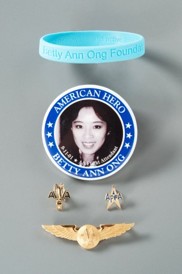
Flight 11 crashed into the World Trade Center’s North Tower at 8:46 a.m.
From a risk management perspective, it took the airline industry less than a day to assess the catastrophe on their business and to ask for a government bailout. On 9/12, while the rubble on ground zero burned, the airline executives, along with dozens of lobbyists, pressed Congress for money. They lost planes and canceled flights, and they imagined a future of negligence lawsuits, canceled insurance, and potential passengers unwilling to fly. And-- they had clout. And change did come-- plenty of change.
For those who don’t know, I began my insurance career as a Workers’ Compensation Adjuster at Sedgwick for self-insured United Airlines. I alone adjudicated United Airlines’ Hawaii claims. I learned quite a bit about providing the airline industry and above all else – the customer service United Airlines strives to impress upon its passengers (much like we try to ensure our clients have a remarkable experience in the claims process).
Anyways, not only did the 9/11 attack change the nation, but it also changed the entire airline industry overnight. A total of sixteen (16) United Airlines crew members were killed on 9/11 on-board two hijacked United flights. Both Flight 175 and Flight 93 were headed to California.

As I engaged with the United Airlines teams in both California and Hawaii, airline employees remembered their fallen colleagues fondly. One inflight supervisor who oversaw the workers' compensation division for United Airlines recalled the morning of 9/11 immediately after the attack. She sped down to LAX on an eerily empty 405 freeway – an apocalyptic scene when it normally is full of traffic in the morning. Her task was to ground all flights and return her team to safety. Keep in mind there was no procedure or manual for such procedure(s) under these circumstances, yet these individuals rose to the occasion and acted behind the scenes without expectation. Then the focus pivoted to helping the families of the 9/11 attacks. So, she shifted to the well-being of her employees and to establishing procedures to minimize the impact of something like this in the future.
The claims piece:
There were many 9/11 workers’ compensation claims filed by workers whose injuries were not caused directly by the attacks of that day but by proximity. Some were filed due to the emotional or mental condition the attack had caused them. These are the infamous psych claims. In workers' compensation, an emotional or mental health condition or disorder arising out of or in the course of employment, may be compensable, including depression, anxiety, post-traumatic stress disorder (PTSD) or stress-related conditions.
The landmark case was Stroka v. United Airlines. A flight attendant was originally scheduled to work the downed Flight 93 (Newark to San Francisco) on 9/11 but for an approved day off chose to be with her family. After learning about the attack and the deaths of team members, she developed a survivor’s guilt and was diagnosed with post-traumatic stress disorder. Ultimately, she was awarded medical and temporary total disability benefits. However, on appeal, the New Jersey court ruled that it was not occupational because the employee's psychological injury must be based on the actual events that happened to the employee, not what might have happened to her. So, because Stroka wasn't on the flight and wasn't working in any capacity, her claim fell outside the scope of occupational injury.
California and Hawaii, the liberal stalwart states that they are, may have ruled differently. Under Labor Code section § 3208.3, California requires an employee to show that actual events of employment are the "predominant" cause (meaning over a 50% threshold) of a psychiatric injury plus a requirement of six months of employment or a "sudden and extraordinary" employment event — a framework quite different from New Jersey's occupational-disease analysis used in Stroka.
What other resources were available at the time?
As a self-insured employer, United Airlines saw the need to implement mitigation efforts early on rather than to wait for all their employees to make individual claims. They did a series of things like extending mental health care to their employees, implementing new procedures and working with the federal government for any additional resources. They also defended against lawsuits to avoid any further legal precedent that would give rise to more claims. Mitigation efforts were costly and ultimately led to their 2002 bankruptcy filing along with other industry-driven factors.
Congress created the 9/11 Victim Compensation Fund “VCF” specifically to compensate victims of the attacks in exchange for their agreement not to sue the airlines, meaning most 9/11-related claims against United and American were funneled into that federal fund rather than into state workers' compensation litigation. This also helped when it could be applied.
Whenever I visited the United Airlines onsite team at LAX, I had to pass a memorial plaque dedicated to those sixteen (16) crew members. Even with the new United Airlines employees, the importance of walking, every single day, and seeing that plaque seems to put things in perspective.
As I am the Hawaii claims manager for Noguchi & Associates, I would be remiss if I failed to mention the nine (9) victims of 9/11 who had ties to Hawaii. They are, in no particular order:
- Heather Ho was a Punahou graduate and pastry chef who worked on the 107th floor of the World Trade Center.
- Richard Lee was another Punahou graduate who was on the 103rd floor of Tower One.
- Maile Hale a 1993 graduate of Kaiser High School was attending a conference at the World Trade Center.
- Georgine Corrigan of Hawaii Kai was on board United Airlines Flight 93 which crashed in Pennsylvania.
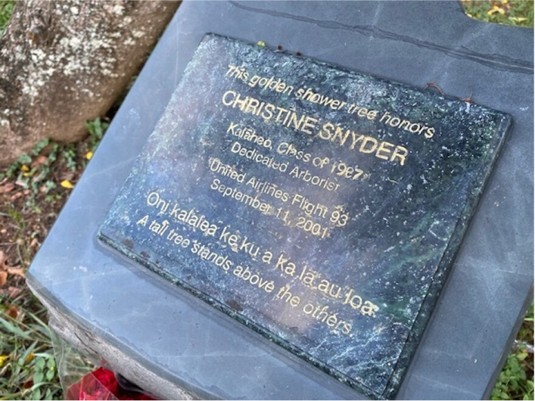
- Christine Snyder of Kailua was also on board Flight 93.
- She has a memorial at Kalaheo High School
- Others with Hawaii ties who died that day include Michael Collins, Richard Keane, Patricia Colodner and David Laychak.
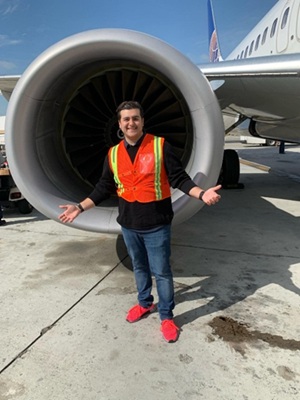
Abraham Alexandria, shown above onsite at LAX in the United Airlines Hanger, is a claims manager for Noguchi & Associates, an Ori-gen family company. Address: 1314 S. King Street, Suite 560, Honolulu, Hawaii. aalexandria@nogins.com
Published and edited by Lonce Lamonte and adjustercom with the permission of Abraham Alexandria.
|


